

PSSM in horses – What is behind the muscle disease polysaccharide storage myopathy?
You are reading this article because the topic of PSSM in horses, also known as Polysaccharide Storage Myopathy, is close to your heart. Perhaps you are seeing muscle tremors, stiff movements, or muscle pain in your horse, or you have heard about the genetic test that can distinguish between variants such as PSSM Type 1 and Type 2.
In this article, you will learn in detail – and in understandable terms – what lies behind this muscle disease in horses, what symptoms are typical, what the diagnosis, management, and therapy look like – and how you can help your horse.
What is PSSM in horses?
PSSM – the abbreviation stands for Polysaccharide Storage Myopathy. It is a genetically determined muscular metabolic disorder in which sugar (glycogen or polysaccharides) is abnormally stored and processed in your horse's muscle cells. Instead of being converted into normal energy, the polysaccharides accumulate in the skeletal muscles – leading to muscle problems and increased discomfort.
There are two variants: PSSM Type 1 and PSSM Type 2, for which the exact genetic defect is usually unknown.
Causes & Variants: PSSM 1 and PSSM 2
PSSM Type 1
PSSM Type 1 is caused by a genetic mutation in the GYS1 gene, which is responsible for the enzyme glycogen synthase 1. This enzyme regulates the formation and storage of glycogen, i.e., stored sugar, in muscle cells. Due to the mutation, too much glycogen is stored in the muscle cells – far more than the muscle needs or can process for energy production. The excess glycogen disrupts normal muscle metabolism and leads to typical symptoms such as muscle stiffness, pain, or a drop in performance.
This form occurs particularly frequently in Quarter Horses, Paint Horses, and some warmblood breeds. The mutation can be reliably detected with a genetic test – the so-called GYS1 test. Depending on whether the horse has one (heterozygous) or two (homozygous) altered gene copies, the severity of the symptoms can vary. Horses with a homozygous mutation are usually more severely affected and require more consistent management.
PSSM Type 2
In contrast to Type 1, there is no GYS1 mutation in PSSM Type 2. The causes of this variant have not yet been fully clarified, but the symptoms are in some cases clearly similar to those of Type 1. For this reason, Type 2 was initially referred to as a diagnosis of exclusion – i.e., as a form of PSSM in horses with typical complaints but a negative GYS1 test result.
Today, it is known that Type 2 probably involves several subforms that are grouped under the term Muscle Integrity Myopathy (MIM). These affect not so much the sugar storage itself, but other aspects of muscle structure and function. To diagnose Type 2, a muscle biopsy is necessary, in which muscle tissue is removed and examined for pathological changes.
Type 2 can occur in many breeds, including horses that do not belong to the typical risk group, such as warmbloods, ponies, and Arabians. Affected animals frequently show symptoms such as stiff movements, muscle tremors, rapid fatigue, or back pain, which are related to a disrupted muscle metabolism.
Mixed forms & variants of PSSM in horses
In some cases, mixed forms of PSSM1 and PSSM2 occur – i.e., horses that carry both a GYS1 mutation and show abnormalities that are typical for Type 2.
In addition, there are other genetic variants that are associated with muscle problems. These are designated P2, P3, P4, P8 and became known primarily in connection with MIM research. Although they are currently not yet officially classified as PSSM types, they provide indications that the range of genetically determined muscle metabolic disorders in horses is greater than previously assumed.
Research into this is still ongoing, but these variants are already being tested by specialized laboratories – especially in horses with typical symptoms but an unclear diagnosis. This shows how complex the topic of PSSM actually is and how important it is not to think of just a single cause when a muscle disease is suspected.
How does the problem of PSSM arise in horses?
With PSSM in horses, the musculature stores an excessive amount of glycogen – these are sugar molecules that normally serve as an energy source. However, in the context of this disease, muscle metabolism is disrupted. The body lacks the correct enzymes to properly process the stored glycogen. Due to this so-called storage myopathy, the sugar is deposited in the muscle cells not only in excessive quantities but also in the wrong form.
This stresses the muscle structure and damages the muscle integrity in the long term. Warmblood breeds are particularly frequently affected, as they have often been bred genetically for high performance, which can favor a certain susceptibility to metabolic imbalances such as PSSM.
Symptoms & typical complaints
For a horse with PSSM, you can look out for the following symptoms:
-
Muscle tremors, especially after exertion
-
Stiffness in walk or trot
-
Muscle loss or visible atrophy in the skeletal muscles
-
Muscle pain, sensitivity to touch
-
Heavy sweating, often even during light work
-
Possible lameness if the musculature is severely damaged
-
General malaise, reduced performance
-
Weight loss or problems with feeding if the musculature suffers chronically
Sometimes PSSM is wrongly portrayed as a fad – a trendy diagnosis. But actual PSSM1 and PSSM2 are real diseases with a biological basis.
Which horse breeds are affected?
In principle, PSSM can occur in many horses, but certain breeds are significantly more affected than others. The disease is particularly well known in Quarter Horses, Paint Horses, and Appaloosas – all of which are breeds that are closely related and in which the genetic predisposition to the GYS1 mutation (PSSM Type 1) is widespread. Warmblood breeds bred for sport, such as Hanoverians, Holsteins, or Oldenburgs, also increasingly show symptoms of PSSM Type 2. In these horses, the focus is usually not on excessive glycogen storage, but on structural or functional weaknesses in the muscle tissue.
But it is not only performance horses that are affected – cold-blooded breeds such as Norikers or Belgians can also develop PSSM, especially Type 1. Since these breeds were originally bred as workhorses, high muscle mass was desired – and with it, apparently, an increased risk of disrupted glycogen storage. Even ponies, Arabians, Icelanders, or other small horse breeds are not completely excluded, even if they are diagnosed less frequently overall.
A particularly insidious aspect is that PSSM often remains undiscovered for a long time because the symptoms are not unambiguous or are wrongly interpreted as a lack of training, resistance, or "crankiness" of the horse. Genetic predisposition plays a decisive role here – because even with the same management and feeding, horses of a certain lineage can be significantly more susceptible than others.
Therefore, it is important not only to pay attention to symptoms but also to consider a genetic test preventively for horses from affected breeds. This allows for early detection of whether a genetic predisposition exists – and you can specifically tailor management, feeding, and training accordingly.
Diagnostics: Genetic test & muscle biopsy in horses
For the diagnosis of PSSM Type 1, a simple genetic test, which is performed either via a blood sample or hair with roots, is suitable. This test can clearly detect the GYS1 mutation. If the result is homozygous – i.e., both gene copies are affected – there is a high risk of pronounced symptoms. If the result is heterozygous, the horse usually shows milder forms of the disease. A negative result rules out PSSM Type 1.
If PSSM is suspected despite a negative genetic test, especially Type 2, a muscle biopsy is carried out in many cases. A small tissue sample is taken and analyzed in the laboratory. If the sample shows an excessive storage of glycogen or insoluble polysaccharides in the muscle cells, this indicates PSSM Type 2 or related variants such as MIM (Muscle Integrity Myopathy). The muscle biopsy is currently the most reliable method to confirm PSSM Type 2 diagnostically, even if it is somewhat more invasive than the genetic test.

Why is PSSM not just "normal muscle twitching"?
Not to be confused with sore muscles: With PSSM, polysaccharides are stored incorrectly in the muscles – a metabolic dysfunction that can lead to long-term muscle damage, inflammation, a drop in performance, or chronic pain. The skeletal musculature suffers permanently if you do not take action.
Therapy & Management: What can you do?
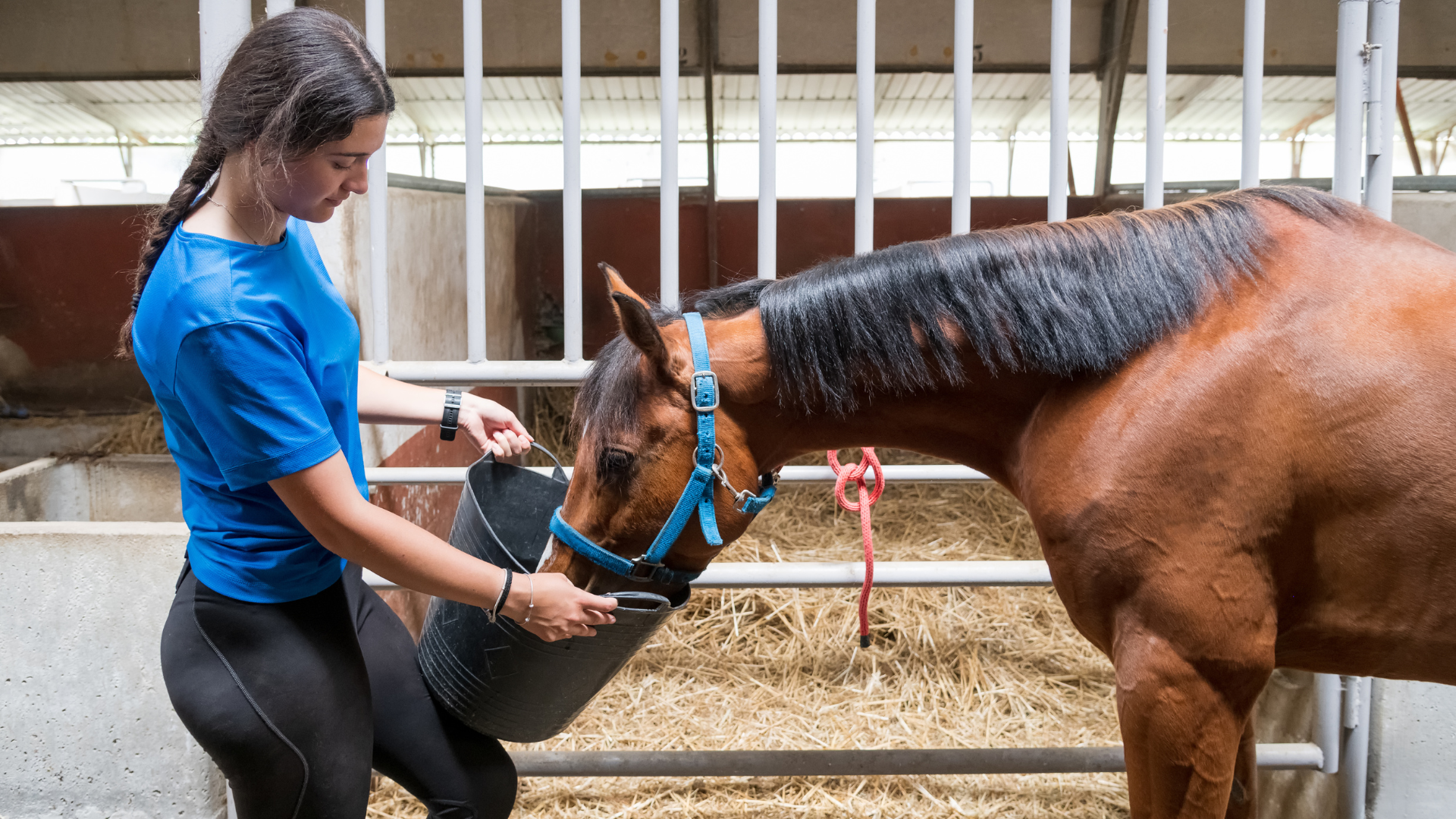
Nutrition & feeding your horse
-
Reduced sugar content (e.g., avoid lightly crushed oats, beet pulp).
-
High proportion of fats, e.g., oil or linseed, provides alternative energy sources.
-
Feeding routine that is as consistent as possible, without sudden changes.
Management & movement
-
Daily exercise, ideally consistent, steady walking.
-
No long periods of box rest, especially not with acute muscle tremors.
-
Sufficient pasture access; if necessary, restriction, but with regular short walks.
Medication & supportive remedies
-
In acute cases, alleviating medication (e.g., anti-inflammatory agents after consultation with a veterinarian).
-
Supplements such as Vitamin E/Selenium to support muscle metabolism.
-
No miracle solution – management through diet and exercise is crucial.
Training & regeneration
-
Gentle rehabilitation programs, adapted to resilience.
-
As consistent strain as possible – no sudden peak loads.
-
Phased muscle building, e.g., with uphill work or lunging.
Recognizing symptoms in everyday life: Step by step
Look at your horse closely:
-
Observe when transitioning or riding whether it trembles or sweats when mounting or at the walk.
-
Watch for stiffness in the morning or after breaks – this can be an indication of muscle load.
-
Regularly check muscle strength and shape – are there signs of atrophy or uneven muscle patterns?
-
Keep a record during growth or performance increases – how are the changes?
-
Note any abnormalities regarding lameness, weakness, fatigue, or pain.
Tips for you & your horse with PSSM
-
Have a genetic test done if you suspect a possible genetic predisposition.
-
If PSSM1 is negative and symptoms persist: consider a muscle biopsy.
-
Rely on low-sugar, high-fat feeding, with consistency.
-
Exercise your horse daily in calm walking phases, avoid long box rest.
-
Speak with an equine veterinarian or feeding expert – individually tailored.
-
Keep a symptom diary (sweating, tremor, lameness log).
-
Snack smart: treats with low starch/sugar content.
-
Pay attention to supplements like Vitamin E & Selenium, if appropriate.
-
Give your horse time for regeneration now; avoid high performance.
-
Network with those affected in the horse world if necessary – experience helps.
Outlook & Classification in the horse world
PSSM is not a fad. It is a hereditary muscle disease that should be taken seriously – easily testable for PSSM Type 1, often more difficult for Type 2. In the horse world, awareness is growing – among breeders, owners, and veterinarians alike – for education and guidance in dealing with PSSM.
With proper management, adapted training, and feeding, you can help your horse live a symptom-free life and perform without pain, muscle loss, or stiffness.
Summary of PSSM in horses – short & concise
PSSM in horses is a serious muscle disease that permanently disrupts muscle metabolism. It occurs in two main forms: PSSM Type 1, triggered by a genetic mutation in the GYS1 gene, and PSSM Type 2, the causes of which have not yet been fully researched but are related to structural problems in the musculature.
Both variants lead to the fact that sugar – in the form of glycogen – is not properly utilized, which overloads the muscle cells and leads to pain, stiffness, muscle weakness, or a drop in performance. Quarter Horses, Paint Horses, and warmblood breeds are particularly frequently affected, but other horses can also become ill.
Diagnosis is carried out via a genetic test for Type 1 or a muscle biopsy if Type 2 is suspected. With the right management, adapted feeding, targeted training, and consistent management, horses with PSSM can often live a largely symptom-free life.
It is crucial that you as a horse owner recognize the symptoms, do not underestimate them, and act early – this way you can enable your horse to have an active and livable life.